If you run a local business website and want to appear in searches like:
- “accountant Bristol”
- “emergency plumber Leeds”
- “family solicitor Birmingham”
…then your service + city page structure matters far more than most people realise.
Many businesses either:
- Create one generic service page and hope Google figures out the locations, or
- Mass-produce hundreds of low-quality “city pages” by swapping out place names
Neither approach works well long term.
Google has become increasingly aggressive at filtering thin, duplicated local landing pages. The sites that consistently perform well are the ones that combine:
- strong service intent
- real local relevance
- proper internal structure
- genuinely useful content
This guide explains how to structure service and location pages properly so they can rank without becoming bloated, repetitive, or spammy.
The Core Structure That Works
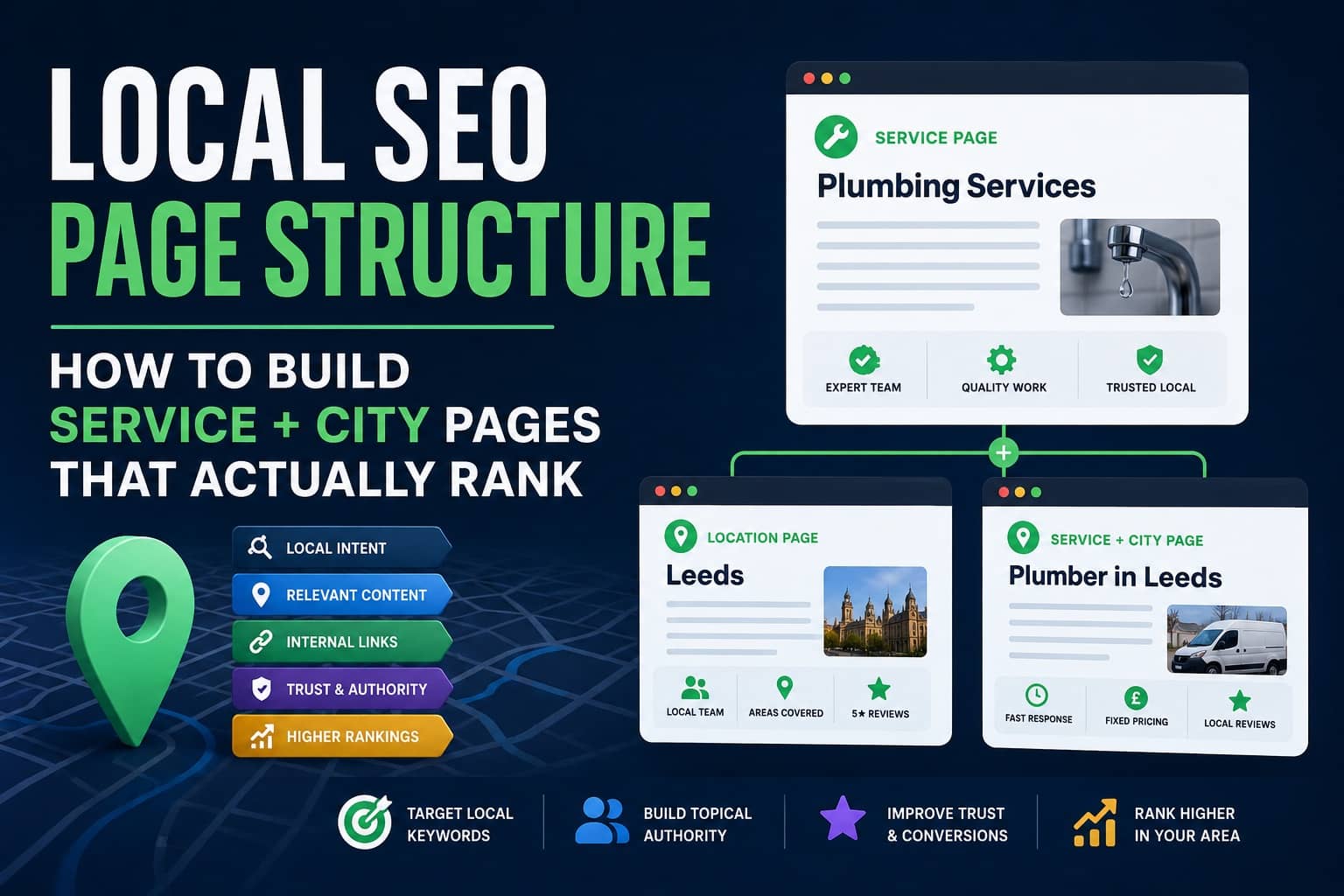
The strongest local SEO setups typically use three content layers:
1. Main Service Pages
These are your core authority pages.
Examples:
/accounting-services//emergency-plumbing//family-law/
These pages explain the service itself in depth.
They should cover:
- what the service is
- who it helps
- process
- pricing guidance
- outcomes
- FAQs
- trust signals
- case studies
- internal links
These pages target broader commercial keywords.
2. Main Location Pages
These establish geographical relevance.
Examples:
/bristol//leeds//birmingham/
These pages should explain:
- your presence in the area
- local industries you work with
- regional challenges
- local examples
- nearby areas served
- client proof
These are not just SEO pages. They help Google understand your genuine relationship to a location.
3. Combined Service + City Pages
This is where local intent is captured.
Examples:
/accountants/bristol//emergency-plumber/leeds//family-solicitor/birmingham/
These pages target highly specific searches with strong buying intent.
Someone searching for “tax accountant Bristol” is often much closer to contacting a business than someone searching simply for “accountant”.
The Biggest Mistake: Thin Duplicate Pages
A huge number of websites fail because they create pages like this:
“We provide professional accounting services in Bristol.”
“We provide professional accounting services in Leeds.”
“We provide professional accounting services in Birmingham.”
…and little else changes.
Google sees this instantly.
Simply replacing city names is not local SEO.
It is template duplication.
Once enough pages exist, rankings often collapse across the whole section.
What Google Actually Wants
Google wants evidence that a page genuinely serves users in that location.
That means your city pages need:
- unique context
- meaningful differences
- local relevance
- useful supporting information
Not just keyword swapping.
How to Add Genuine Local Relevance
Talk About Local Business Context
Different cities have different commercial environments.
For example:
Bristol
Businesses may care more about:
- creative industries
- tech start-ups
- sustainability positioning
- flexible growth support
Leeds
Businesses may care more about:
- fast response times
- regional competition
- operational efficiency
- value-focused services
Your copy should reflect this naturally.
Mention Nearby Areas
Good local pages often include nearby towns and service areas naturally.
Example:
“We support businesses across Leeds, Headingley, Horsforth, Roundhay and the wider West Yorkshire area.”
This strengthens regional relevance without stuffing keywords.
Use Local Examples
Even one genuine example helps massively.
Examples:
- local case studies
- recognisable landmarks
- local industries
- regional regulations
- area-specific customer challenges
This creates authenticity Google can detect.
Structure of a High-Performing Service + City Page
A strong page structure usually looks like this:
1. Clear Local Intent Heading
Example:
Emergency Plumber in Leeds
Avoid clever headlines that hide the keyword.
Google and users should instantly understand:
- service
- location
- intent
2. Local Problem Statement
Explain the local challenge.
Example:
Many Leeds homeowners struggle to find reliable emergency plumbers during evenings and weekends, especially during winter when boiler failures and frozen pipes become more common. Fast response times and transparent pricing are often the deciding factors when choosing a provider.
This immediately creates contextual relevance.
3. Service-Specific Outcomes
Focus on practical outcomes, not vague marketing language.
Strong examples include:
- faster response times
- reduced downtime
- improved compliance
- fewer repeat issues
- clearer pricing
- improved customer trust
- long-term reliability
Avoid meaningless filler like:
- “industry-leading”
- “next-generation”
- “world-class”
Specificity wins.
4. Explain Your Process
This improves trust and depth.
Examples:
- initial consultation
- diagnosis
- quotation
- repair or implementation
- testing
- aftercare
Detailed process sections also naturally increase topical authority.
5. Proof and Trust Signals
This section matters enormously.
Include:
- testimonials
- case studies
- years of experience
- before/after examples
- client types
- certifications
- review counts
Google increasingly evaluates trust signals when ranking local commercial pages.
6. Internal Links
This is one of the most overlooked ranking factors.
Every service + city page should link to:
Related services
Examples:
- boiler servicing
- leak detection
- bathroom installation
Nearby locations
Examples:
- Leeds
- Bradford
- Wakefield
Supporting resources
Examples:
- maintenance guides
- cost breakdown articles
- troubleshooting resources
Strong internal linking helps Google understand:
- topic clusters
- location clusters
- authority flow
7. Relevant FAQs
FAQs help capture long-tail searches and improve topical completeness.
Good local SEO FAQs include:
Should every service be duplicated for every city?
Only if each page adds unique local value.
What causes local pages to underperform?
Thin copy, weak internal links, and unclear local relevance.
How many location pages should a website have?
Only create pages where you genuinely offer services and can add meaningful local context.
Are service + city pages still effective for SEO?
Yes, when they are genuinely useful and properly structured.
Should location pages contain reviews?
Absolutely. Reviews strengthen local trust and conversion rates.
8. Clear Next-Step CTA
Do not finish with weak generic wording like:
- “Contact us today”
- “Get in touch”
Instead explain the next action clearly.
Example:
Need a fast-response emergency plumber in Leeds? Request a callback and we’ll assess the issue, provide transparent pricing, and arrange the earliest available visit.
Specific CTAs convert better.
Avoid Overbuilding Hundreds of Pages
Many businesses damage their own site quality by creating:
- 50 services
- across 100 cities
- generating 5,000 thin pages
This rarely ends well.
A smaller number of genuinely useful pages almost always outperforms mass-generated SEO pages.
Focus on:
- quality
- depth
- relevance
- internal linking
- trust
Not sheer page count.
Recommended Site Structure
A clean structure often looks like this:
/services/
/locations/

/accounting-services/
/emergency-plumbing/
/family-law/

/bristol/
/leeds/
/birmingham/

/accounting-services/bristol/
/emergency-plumbing/leeds/
/family-law/birmingham/
This structure helps Google understand:
- service relationships
- location relationships
- topical authority
- internal hierarchy
Final Thoughts
Local SEO pages still work exceptionally well when done properly.
But Google is increasingly filtering:
- duplicate content
- AI-generated filler
- doorway pages
- low-value city pages
The websites that continue to win are the ones that combine:
- genuine expertise
- useful local relevance
- strong structure
- trust signals
- proper internal linking
- high-quality content
The goal is not to create “SEO pages”.
The goal is to create the best page on the internet for someone searching for that service in that location.
Related services
FAQs
Only if each page adds unique local value.
Thin copy, weak internal links, and unclear local relevance.