Search is changing rapidly.
Traditional Google rankings still matter, but more people are now discovering businesses through AI-generated answers inside platforms like:
- Google AI Overviews
- OpenAI ChatGPT
- Microsoft Copilot
- Perplexity AI
- voice assistants and AI-driven search tools
Instead of showing ten blue links, these systems increasingly generate direct answers.
That changes how local and service-based businesses need to think about visibility.
The businesses most likely to appear in AI-generated answers are usually the ones with:
- structured information
- clear expertise
- trustworthy signals
- strong topical coverage
- consistent entity data
This guide explains a practical starter framework for improving AI search visibility for local businesses using GEO and AEO principles.
What Are GEO and AEO?
You may start hearing these terms more frequently.
GEO: Generative Engine Optimisation
GEO focuses on helping AI systems understand and reference your business within generated responses.
This includes:
- entity clarity
- topical authority
- structured information
- trust signals
- citation-worthy content
AEO: Answer Engine Optimisation
AEO focuses on making your content easy for answer engines to extract and summarise.
This often includes:
- direct answers
- FAQs
- structured headings
- concise explanations
- semantic clarity
In practice, GEO and AEO overlap heavily.
Both are really about helping AI systems:
- understand your business
- trust your information
- confidently reference your content
Why AI Visibility Matters for Local Businesses
Many service businesses still focus entirely on traditional rankings.
But increasingly, customers are asking AI tools questions like:
- “Who is the best family solicitor in Manchester?”
- “What should a kitchen extension cost in Bristol?”
- “Who offers emergency boiler repair near Leeds?”
- “What’s the best-rated accountant for small businesses in Glasgow?”
AI systems now summarise information directly.
If your business becomes part of those summaries, visibility can increase significantly.
If your competitors become the trusted entities instead, your organic exposure may slowly decline even if rankings remain stable.
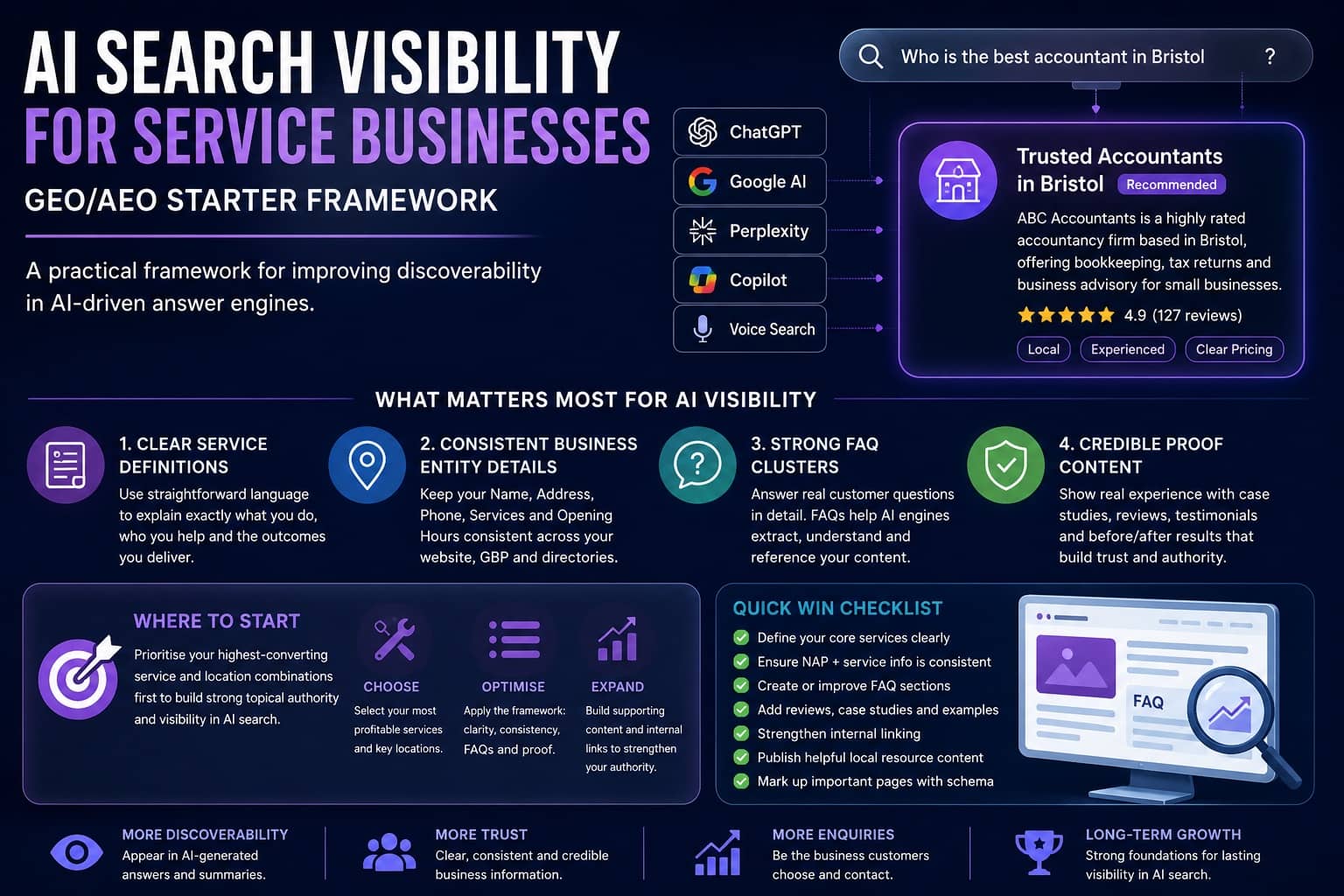
What Matters Most for AI Search Visibility
Many businesses overcomplicate AI optimisation.
In reality, most service businesses should focus on a few core foundations first.
1. Clear Service Definitions
AI systems struggle when businesses describe themselves vaguely.
For example:
“We provide innovative digital solutions for modern commercially useful organisations.”
This sounds polished but says almost nothing.
Instead, clarity wins.
Example:
“We provide bookkeeping and VAT return services for small businesses across Birmingham and the West Midlands.”
AI systems prefer:
- explicit services
- clear terminology
- understandable business categories
- direct explanations
The easier your business is to classify, the easier it becomes to reference.
2. Consistent Business Entity Details
Entity consistency is becoming increasingly important.
Your business information should match across:
- website
- Google Business Profile
- directories
- social profiles
- citations
- schema markup
This includes:
- business name
- address
- phone number
- services
- opening hours
- service areas
Inconsistent information creates uncertainty.
AI systems tend to favour businesses with strong entity confidence.
3. Strong FAQ Clusters
FAQs are one of the most effective AEO assets available.
Why?
Because users naturally ask AI tools questions conversationally.
Good FAQ content helps answer engines:
- understand context
- extract concise responses
- connect related topics
- identify expertise
Weak FAQ Example
“Do you offer quality service?”
This provides little value.
Strong FAQ Example
“How long does a loft conversion usually take in Birmingham?”
This:
- reflects real search behaviour
- creates local relevance
- demonstrates topical depth
- supports AI extraction
The strongest FAQ clusters usually focus on:
- pricing
- timelines
- process
- expectations
- comparisons
- misconceptions
- local considerations
4. Credible Proof Content
AI systems increasingly favour content that demonstrates:
- real experience
- trustworthiness
- expertise
- authority
That means generic marketing pages alone are becoming less effective.
Strong proof content includes:
- case studies
- reviews
- testimonials
- before-and-after examples
- project walkthroughs
- statistics
- named examples
- local examples
Example
Instead of:
“We are trusted by businesses.”
Use:
“We helped a Leeds-based manufacturing company reduce average enquiry response times from 18 hours to under 2 hours after rebuilding their customer portal.”
Specificity builds credibility.
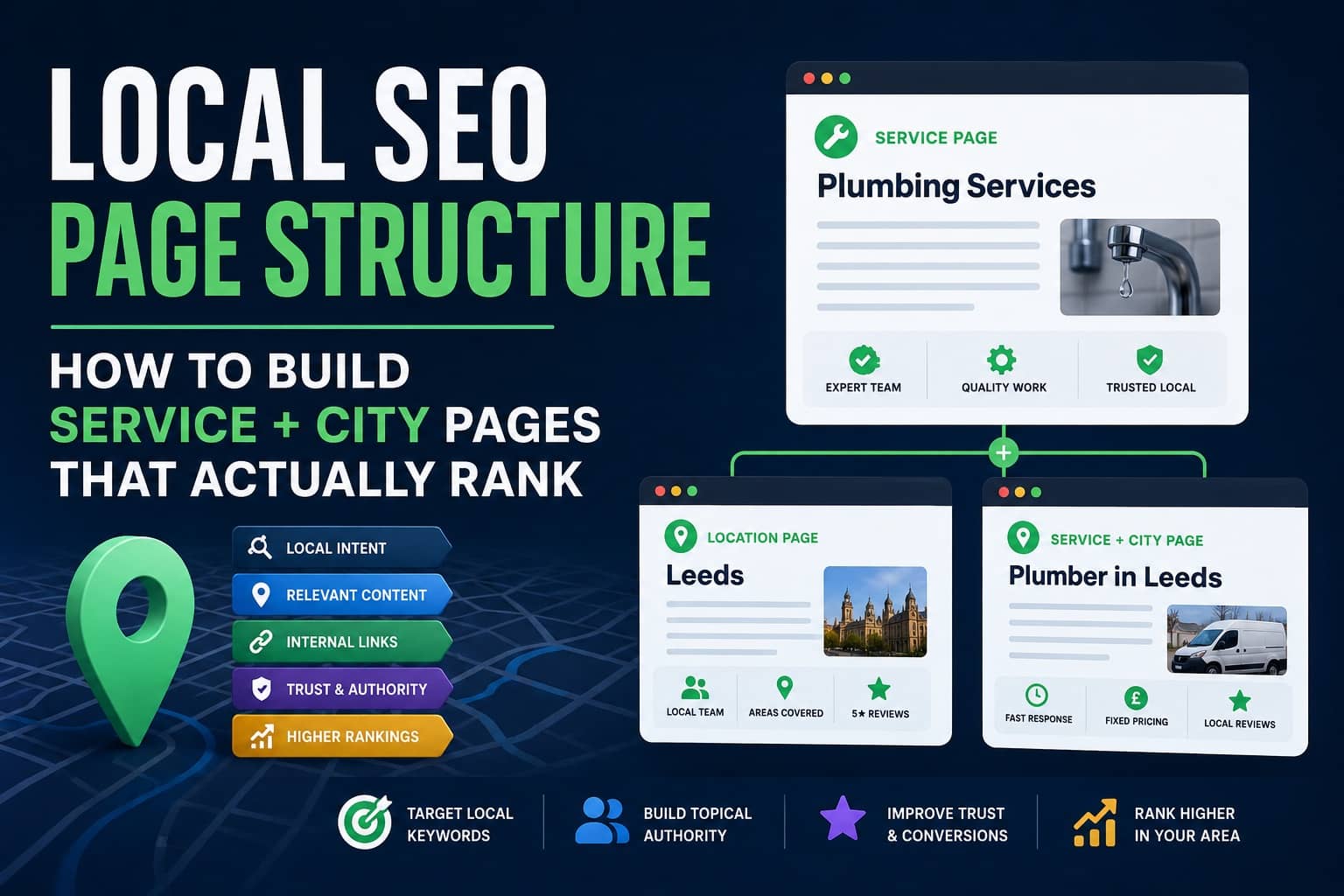
Service + Location Coverage Matters More Than Ever
AI systems increasingly connect:
- service relevance
- location relevance
- topical authority
That means businesses should build structured content around:
- primary services
- key locations
- supporting resources
Example structure:
/services/
/locations/
/resources/

/commercial-cleaning/
/office-cleaning/
/industrial-cleaning/

/manchester/
/liverpool/
/leeds/

/office-cleaning/manchester/
/industrial-cleaning/leeds/
This helps answer engines understand:
- what you do
- where you do it
- how topics connect
Build Topical Depth Around Real Questions
One of the best ways to improve AI discoverability is by creating genuinely useful resource content.
AI systems often pull information from pages that:
- explain clearly
- answer directly
- provide supporting context
Examples:
- pricing guides
- comparison articles
- timelines
- process explainers
- mistake-prevention guides
- local industry insights
What AI Systems Tend to Prefer
Although algorithms differ, answer engines often favour content that is:
- easy to understand
- well structured
- semantically clear
- trustworthy
- entity-consistent
- specific
- genuinely helpful
They struggle more with:
- vague marketing copy
- keyword stuffing
- thin city pages
- repetitive AI-generated filler
- unclear expertise
Schema Still Helps
Structured data still matters.
Useful schema types may include:
- LocalBusiness
- Service
- FAQPage
- Review
- Article
- Breadcrumb
- Organisation
Schema does not guarantee visibility, but it helps machines interpret content more reliably.
Internal Linking Is Becoming Even More Important
AI systems increasingly rely on contextual relationships between pages.
Strong internal linking helps reinforce:
- topic authority
- service relationships
- location relationships
- entity relevance
For example:
A “Commercial Electrician Manchester” page might link naturally to:
- electrical testing
- emergency callouts
- PAT testing
- nearby service areas
- related guides
This creates stronger semantic context.
Where to Start
Many businesses make the mistake of trying to optimise everything at once.
That usually leads to:
- inconsistent content
- unfinished pages
- diluted authority
Instead:
Prioritise your highest-converting service and location combinations first.
For example:
- “Emergency Plumber Leeds”
- “Business Accountant Bristol”
- “Family Solicitor Birmingham”
Focus on:
- clarity
- trust
- structure
- useful FAQs
- supporting proof
Then expand gradually.
Practical GEO/AEO Starter Checklist
Clarify Your Core Services
Make sure every service page explains:
- what you do
- who it helps
- outcomes
- process
- location relevance
Standardise Business Information
Ensure all platforms show consistent:
- business name
- address
- phone number
- services
- URLs
Build FAQ Clusters
Create useful FAQ sections around:
- pricing
- timelines
- local considerations
- process
- comparisons
Improve Proof Content
Add:
- testimonials
- reviews
- project examples
- case studies
- statistics
- photos
Strengthen Internal Linking
Connect:
- services
- locations
- guides
- FAQs
- case studies
Create Helpful Resource Content
Focus on:
- real customer questions
- practical explanations
- local intent
- industry expertise
Common Mistakes
Writing for Algorithms Instead of Humans
AI systems increasingly reward genuinely useful content.
Creating Thin AI-Generated Pages
Large volumes of low-quality content rarely perform well long term.
Ignoring Entity Consistency
Conflicting business information weakens trust signals.
Using Generic Marketing Language
Vague wording reduces semantic clarity.
Final Thoughts
AI-driven search is still evolving rapidly, but the foundations are already becoming clear.
The businesses most likely to gain visibility are usually the ones that are:
- easiest to understand
- easiest to trust
- easiest to classify
- richest in useful information
For local service businesses, this is actually good news.
Most competitors are still relying on:
- thin location pages
- generic copy
- weak structure
- outdated SEO tactics
A clear GEO/AEO strategy creates a major opportunity to build visibility before AI search becomes even more competitive.
The goal is not to “optimise for AI”.
The goal is to become the clearest, most trustworthy source of information in your service area so AI systems naturally choose to reference you.
FAQs
Yes. It overlaps with SEO but depends heavily on clarity and structured entities.
Use schema where relevant and truthful; structure still matters most.